
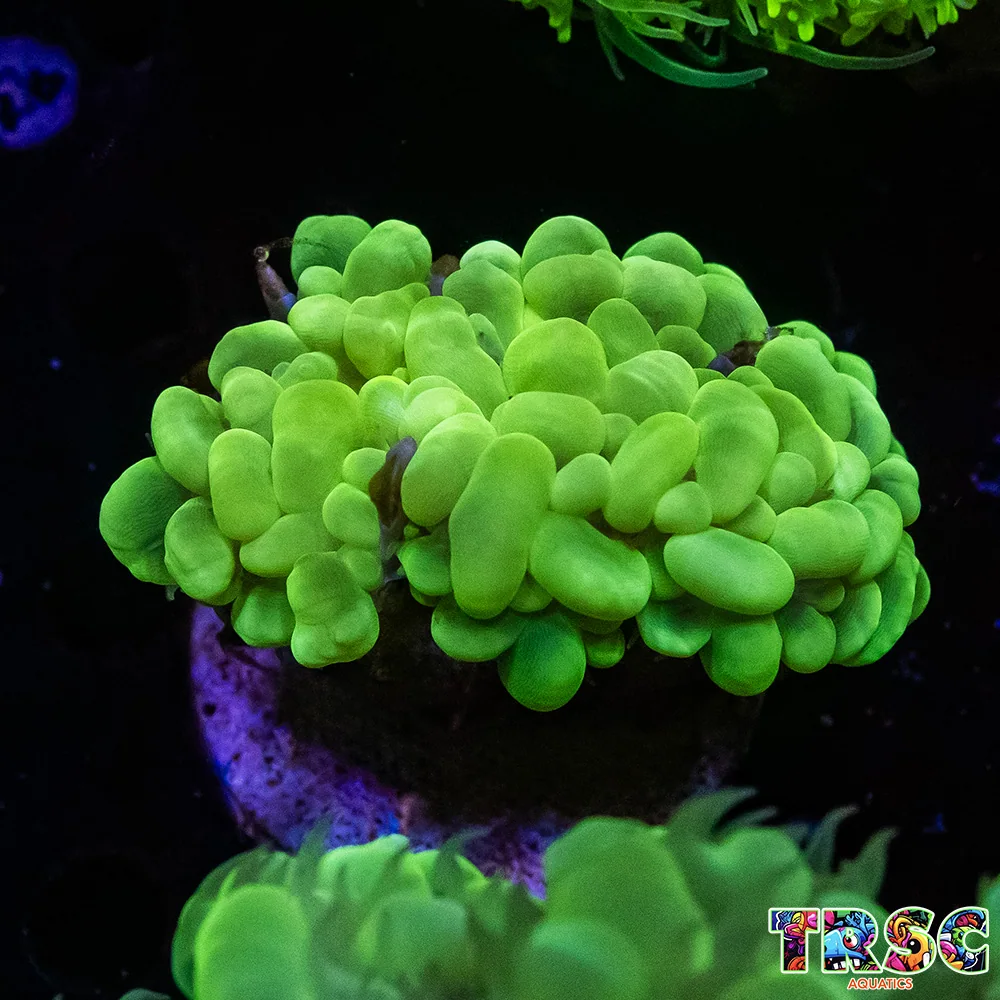
Bubble Coral (Plerogyra sinuosa) B07
Market Intelligence
Based on 44 similar Bubble corals
Market insights from thousands of listings
About this coral
Bubble Coral Care Guide (Plerogyra sinuosa)
Bubble Coral (Plerogyra sinuosa) is a large polyp stony coral covered in large, water-filled bubbles that can reach about an inch across. The bubbles inflate during the day and pull in at night, when the feeding tentacles come out. It is hardy, adaptable and a dramatic centerpiece.
Bubble Coral Care
Bubble Coral is a hardy, dramatic LPS covered in large, glassy bubbles. It is easy to keep, but it is aggressive and needs plenty of room.
Location
Wild Bubble Coral is found on sheltered lower reef slopes and in caves across the Red Sea and Indo-Pacific. Ours are aquacultured on our farm, so they are already used to aquarium life.
Lighting
| 0 | 100 | 200 | 300 | 400 |
Low to moderate light, around 50–150 PAR, is plenty. Strong light can make the bubbles shrink. Place it on the sand or low on the rockwork, ideally somewhere sheltered. Leave plenty of space around it, since the bubbles and the night-time tentacles both need room.
Water Flow
Low to moderate, indirect flow is best. Strong flow can tear the bubbles against the sharp skeleton beneath.
Feeding
Bubble Coral is photosynthetic but grows best when fed. Offer mysis, chopped krill or other meaty foods in the evening when the tentacles are out.
Water Chemistry
- Alkalinity: 8–9 dKH. Keep it steady; swings matter more than the exact number
- Calcium: 400–450 ppm
- Magnesium: 1300–1400 ppm
- Nitrate: 5–10 ppm. Readings of 30–40 ppm can cause tissue recession
- Phosphate: 0.03–0.1 ppm
- Salinity / Temp: 1.025–1.026 SG, 76–79°F
Propagation
It can be fragged by cutting the skeleton between heads with a saw. Bubble corals also sometimes drop buds that settle and grow into new colonies.
Troubleshooting
- Bubbles shrinking or staying closed: Too much light, too much flow or a water swing
- Torn bubbles: Contact or strong flow. They often heal in good water
Aggression
Bubble Coral is aggressive. Its sweeper tentacles at night can reach several inches and sting neighbors badly. Give it lots of space.
Acclimation
Always handle it by the skeleton, never by the bubbles. Float the bag to match temperature, then slowly drip or cup in tank water over 20–30 minutes. Give it a coral dip to knock off hitchhikers like flatworms before it goes in. Start it low in the tank under gentler light and move it up over a couple of weeks if it looks happy. Expect it to stay closed for a day or two while it settles.
Aquacultured at TRSC Aquatics in Charlotte, NC.
Care requirements

Delivery options
Nationwide delivery available
Charlotte, NC
Listing stats
Market insights from thousands of listings
Compare Similar Bubble Corals
See how this listing stacks up against 44 other options


More from TRSC Aquatics
Explore 493 listings from this seller
Dive into Meta Reef
Discover corals and build your reef — all in one place.
Already have an account? Log in