
Clove Coral Care Guide
Clove Polyps are beginner-friendly soft corals known for their distinctive feathery tentacles and easy care requirements. This care guide covers lighting, water flow, placement, and propagation tips to help reef keepers of all experience levels maintain thriving Clove Polyp colonies.
About Clove
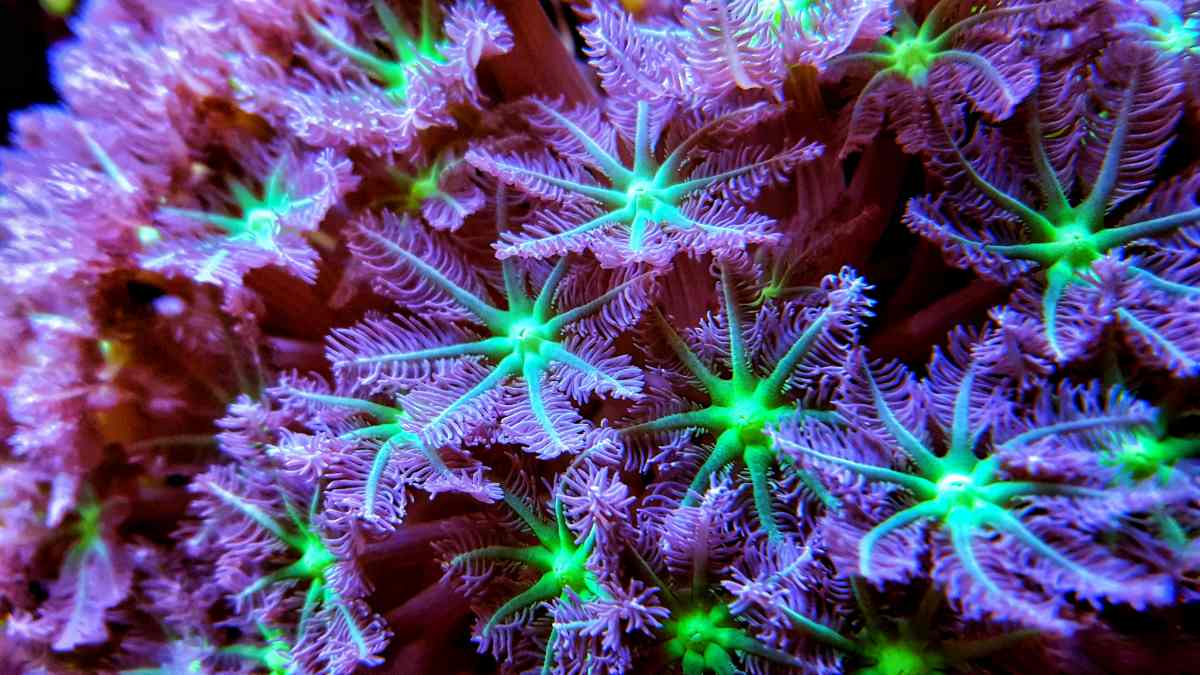
Clove Polyps (Clavularia viridis) are soft corals belonging to the subclass Octocorallia, featuring eight feathery tentacles with pinnate margins that resemble miniature palm trees or ferns. Clove Polyps display colors ranging from green, pink, and purple to white and brown, with polyps extending 2-3 inches from a purple stolon mat that encrusts rock surfaces. Clove Polyps require low to moderate lighting of 50-150 PAR and moderate indirect water flow, making the species one of the most forgiving soft corals for beginning reef keepers.
Clove Polyps tolerate parameter fluctuations that would stress stony corals, thriving in systems with nitrate levels between 5-20 ppm where other corals might struggle. Clove Polyp colonies spread across rock surfaces via stolons that produce new polyps, though growth rates vary significantly between color varieties with green and yellow-tipped morphs spreading faster than pink or white varieties.
Care Requirements
Quick overview for keeping your coral thriving
Difficulty
Beginner Friendly
Lighting
Low to Moderate
Water Flow
Moderate
Detailed Care Guide
In-depth information for optimal care
Difficulty Level
Beginner Friendly
Clove Polyps rank among the easiest soft corals to maintain in reef aquariums, tolerating parameter swings in alkalinity, calcium, and magnesium that would damage stony corals. Clove Polyps lack calcified skeletons, allowing the species to adapt to varying water chemistry without the strict stability requirements of LPS or SPS corals.
Clove Polyps thrive in systems where some nitrate is present (5-20 ppm), actually struggling in ultra-low nutrient systems where nitrate and phosphate approach zero. Beginning reef keepers find Clove Polyps forgiving of common mistakes while learning to maintain stable reef environments.
Lighting Requirements
Low to Moderate
Clove Polyps thrive under low to moderate lighting between 50-150 PAR, with the species adapting to both lower and higher intensities when acclimated gradually over 2-3 weeks. Clove Polyps are photosynthetic, deriving most nutrition from zooxanthellae, though the species tolerates lower light levels than many other soft corals.
Clove Polyp coloration responds to lighting intensity, with higher PAR levels enhancing vibrant greens and pinks while insufficient light causes polyps to stretch toward the light source. Placement in mid-tank positions typically provides appropriate lighting for most aquarium setups.
Water Flow
Moderate
Clove Polyps prefer moderate, indirect water flow that keeps polyps gently swaying without causing retraction from excessive current. Clove Polyps close when exposed to strong direct flow, requiring randomized or pulsing flow patterns rather than laminar streams aimed directly at the colony.
Clove Polyp colonies mounted vertically benefit from flow that prevents detritus accumulation on the stolon base, as debris buildup blocks light and promotes tissue death. Flow rates of 10-20 times tank volume per hour with indirect positioning typically produce optimal polyp extension.
Keep your Clove healthy
Save photos, placement, parameters, and what you paid — and see how your Clove changes over time.
Parameters
In range8.5 dKH
Alkalinity target 8–9 dKH · sample data
Your Clove
just added$45 paid
value from live market
Buying Advice
What to look for when purchasing
Polyp Extension
Select Clove Polyp frags displaying fully extended polyps with feathery tentacles spread open, indicating healthy specimens acclimated to store conditions. Avoid frags with persistently closed polyps, as extended closure may indicate stress, disease, or specimens unlikely to adapt to new environments.
Stolon Health
Examine the purple stolon mat at the base for full coverage without bare patches, algae overgrowth, or signs of recession. Healthy Clove Polyp stolons appear firm and well-attached to the substrate, while deteriorating specimens show lifting edges or pale discoloration.
Color Vibrancy
Choose specimens with vibrant, consistent coloration matching the variety (green, pink, purple, or white). Faded or brownish coloration may indicate stress from improper lighting or poor water quality at the source.
Mounting Surface
Clove Polyps mounted on small rock plugs or frag discs are easier to place and relocate than specimens attached to large rock pieces. Consider containment strategy before purchase, as Clove Polyps will spread to any connected rock surfaces over time.
Taxonomy
Species
Reef Value
Live pricing$1,860
+$120 this month
Priced from live marketplace listings
Clove
Just added · Frag rack
$45
Hammer Coral
8 months · Mid rock
$65
Zoa Colony
1 year · Sand bed
$40
Track Your Reef
Add your Clove to your tank's living inventory — placement, source, and photos as it grows — next to the parameter logs and maintenance history that keep it thriving. Reef Value even shows what your collection is worth, priced from live marketplace listings.
Find Your Perfect Clove
Compare prices from 11+ verified sellers. From budget-friendly frags to rare collector pieces.
Starting at
$10
Average Price
$45
Premium frags up to
$329
Full Price History
Trends, movers & market data
Frequently Asked
Common questions about Clove corals
Are Clove Polyps good for beginners?
Clove Polyps rank among the best coral choices for beginning reef keepers due to their tolerance for parameter fluctuations and forgiving care requirements. Clove Polyps lack calcified skeletons, allowing the species to survive alkalinity and calcium swings that would damage stony corals, making Clove Polyps ideal for aquarists still learning to maintain stable water chemistry.
Clove Polyps actually prefer some nutrients in the water column, thriving in tanks with 5-20 ppm nitrate where beginners often struggle to achieve the ultra-low nutrient levels required by demanding SPS corals. New reef keepers can expect Clove Polyps to survive common mistakes while developing husbandry skills.
Why are my Clove Polyps not opening?
Clove Polyps remain closed when experiencing stress from improper water flow, inadequate lighting, recent relocation, or nutrient deficiency in ultra-clean systems. Clove Polyps require moderate indirect flow and close immediately when exposed to strong direct current or placed in low-flow dead spots where detritus accumulates on the stolon base.
Clove Polyps newly introduced to an aquarium commonly stay closed for several days to two weeks during acclimation, and reef keepers should avoid moving specimens during this adjustment period. Clove Polyps prefer some dissolved nutrients, often declining in tanks with nitrate and phosphate at undetectable levels where the species cannot obtain sufficient nutrition through photosynthesis alone.
How fast do Clove Polyps spread?
Clove Polyps spread via stolons that creep across rock surfaces and produce new polyps, though growth rates vary significantly between color varieties and individual specimens. Green Clove Polyps and yellow-tipped varieties spread considerably faster than pink or white morphs, with some colonies covering several inches of rock surface within months under optimal conditions.
Clove Polyp growth rates often disappoint aquarists expecting Xenia-like explosive spreading, as most Clove Polyp varieties grow relatively slowly compared to other soft corals despite their similar appearance. Reef keepers wanting faster colony expansion should ensure moderate flow, appropriate lighting, and maintain nitrate levels between 5-15 ppm.
Will Clove Polyps take over my tank?
Clove Polyps can spread across connected rock surfaces via stolons but typically grow slowly enough to manage through occasional pruning or physical barriers. Clove Polyps spread like strawberry plants through runners rather than encrusting like Green Star Polyps, potentially covering greater distances when given continuous rock pathways between areas.
Reef keepers concerned about Clove Polyp spreading should place colonies on isolated rock islands surrounded by sand, preventing stolons from reaching the main aquascape. Clove Polyps cannot attach to sand substrate, making isolation an effective containment strategy for aquarists wanting to enjoy the species without risking overgrowth.
What lighting do Clove Polyps need?
Clove Polyps require low to moderate lighting between 50-150 PAR, adapting to both lower and higher intensities when acclimated gradually over several weeks. Clove Polyps are photosynthetic soft corals that derive nutrition from symbiotic zooxanthellae, though the species tolerates dimmer conditions than many reef corals and does not require intense lighting to thrive.
Clove Polyps placed in areas below 50 PAR may stretch toward light sources and display reduced coloration, while specimens under very high PAR risk bleaching without proper acclimation. Mid-tank placement under standard reef lighting typically provides appropriate intensity for healthy Clove Polyp colonies.
Do Clove Polyps need to be fed?
Clove Polyps are photosynthetic corals that obtain most nutrition from zooxanthellae and typically do not require direct feeding in well-lit aquariums with some dissolved nutrients. Clove Polyps can capture fine particulate foods from the water column as filter feeders, benefiting from occasional broadcast feeding of phytoplankton, reef roids, or finely minced foods.
Clove Polyps in ultra-low nutrient systems may benefit from supplemental feeding when nitrate and phosphate levels approach zero. Reef keepers maintaining Clove Polyps in nutrient-poor environments should consider target feeding every few days or allowing slightly higher nutrient levels that the species prefers.
All Soft Corals
Browse the complete collection of Soft coral care guides