
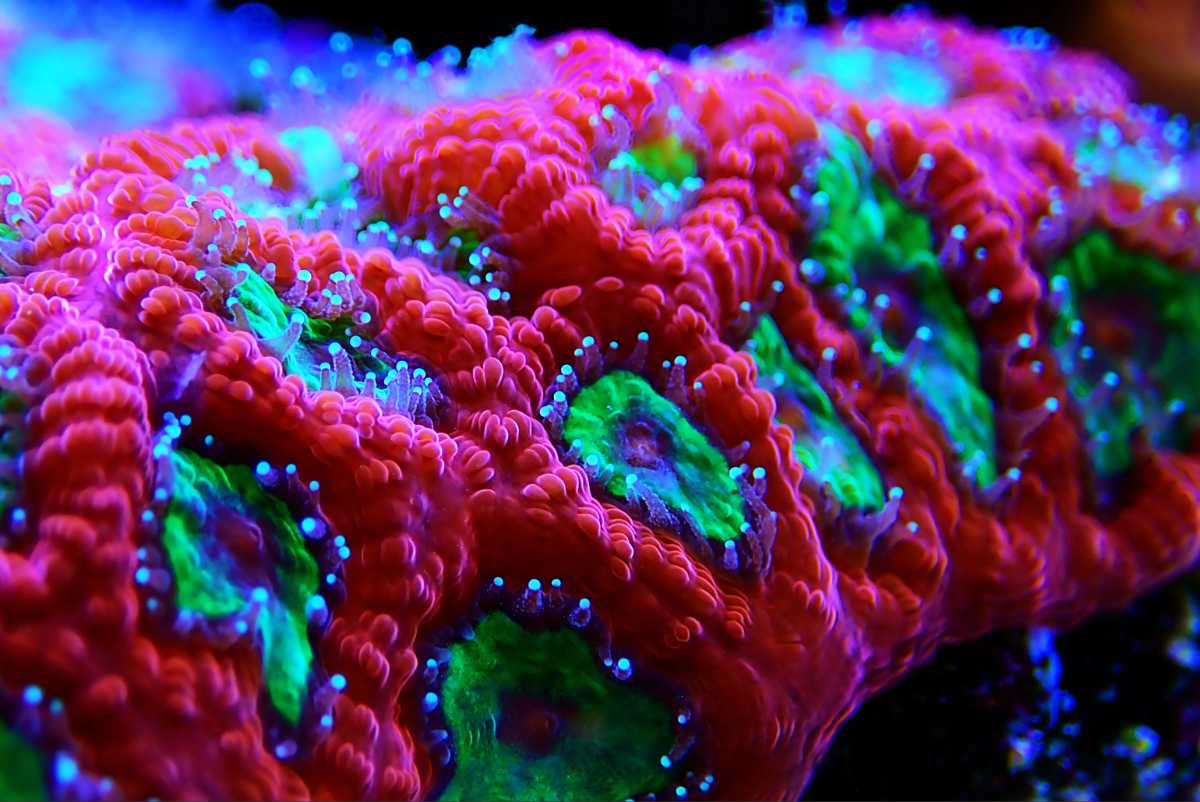
Favia Coral Care Guide
Favia corals are beginner-friendly LPS corals known for their dome-shaped colonies and striking color combinations. This care guide covers lighting, water flow, placement, and feeding to help reef keepers of all experience levels maintain healthy Favia colonies in their aquariums.
About Favia
Favia coral is a large polyp stony coral known for its dome-shaped colonies and bold color patterns featuring contrasting polyp centers. Favia colonies display vibrant combinations of green, red, orange, blue, and purple, with individual corallites separated by distinct walls that distinguish Favia from the closely related Favites genus. Favia coral thrives under low to moderate lighting between 50-150 PAR and moderate water flow, making Favia an excellent choice for beginner reef keepers seeking a hardy LPS coral.
Favia coral extends feeding tentacles at night and can capture small meaty foods like mysis shrimp and reef roids, though regular feeding is optional since Favia obtains most nutrition through photosynthesis. Favia coral produces sweeper tentacles extending 2-6 inches at night, requiring 3-4 inches minimum spacing from neighboring corals to prevent stinging damage to tank mates.
Care Requirements
Quick overview for keeping your coral thriving
Difficulty
Beginner Friendly
Lighting
Low to Moderate
Water Flow
Moderate
Detailed Care Guide
In-depth information for optimal care
Difficulty Level
Beginner Friendly
Favia coral tolerates a wide range of lighting and flow conditions, making Favia forgiving for new reef keepers learning to maintain stable water parameters. The species adapts well to various tank placements and does not require target feeding to survive, though fed specimens display faster growth and fuller tissue.
Favia coral's primary care consideration involves managing sweeper tentacle aggression by providing adequate spacing from neighboring corals, which requires observation during nighttime hours when tentacles extend.
Lighting Requirements
Low to Moderate
Favia coral performs best under low to moderate lighting between 50-150 PAR, with many experienced reef keepers recommending the 50-100 PAR range to prevent bleaching. Favia coral placed too close to intense lighting risks losing zooxanthellae and bleaching, which is more common than light starvation in reef aquariums.
Reef keepers should acclimate new Favia specimens by starting placement lower in the tank and gradually moving the coral higher over several weeks if desired. A 14-20K color spectrum enhances Favia coral coloration under LED, T5, or metal halide lighting.
Water Flow
Moderate
Favia coral thrives in moderate water flow that keeps the coral surface clean and delivers food particles to the polyps without causing tissue retraction. Flow rates between 10-20x tank turnover per hour work well for most Favia colonies.
Excessive flow causes Favia polyps to remain retracted and can damage tissue over time, while insufficient flow allows detritus to accumulate on the coral surface and reduces the coral's ability to capture food particles.
Keep your Favia healthy
Save photos, placement, parameters, and what you paid — and see how your Favia changes over time.
Parameters
In range8.5 dKH
Alkalinity target 8–9 dKH · sample data
Your Favia
just added$40 paid
value from live market
Favia Taxonomy Reclassification
Favia coral underwent major taxonomic revision that reduced the genus from nearly 100 species to only two valid species: Favia fragum and Favia gravida, both native to the Caribbean. Since Caribbean stony corals are illegal to collect for the aquarium trade, virtually all corals sold as "Favia" in reef stores actually belong to reclassified Indo-Pacific genera including Dipsastraea, Goniastrea, and Coelastrea.
Reef keepers should understand that the "Favia" trade name persists despite this reclassification, and care requirements remain consistent regardless of the coral's true taxonomic identity. The key identifying feature of true Favia (distinct walls around each corallite) now applies primarily to distinguishing between the various reclassified genera rather than identifying actual Favia species in the hobby.
Buying Advice
What to look for when purchasing
Polyp Extension
Healthy Favia coral displays puffy, extended tissue during the day with individual polyps visible and not sunken into the skeleton. Avoid specimens showing retracted tissue or exposed skeletal ridges, which indicate stress or declining health.
Tissue Coverage
Examine the entire Favia colony for complete tissue coverage with no exposed white skeleton. Tissue recession starting from the edges or appearing as holes within the colony indicates disease, pest damage, or poor water quality at the source facility.
Color Vibrancy
Select Favia specimens with vibrant, saturated colors rather than pale or washed-out appearance. Fading colors may indicate bleaching from excessive lighting at the source tank, though such specimens can recover with proper acclimation to appropriate light levels.
Pest Inspection
Inspect Favia coral for flatworms, nudibranchs, or other pests before purchase. Quarantine and dip all new Favia specimens in a coral dip solution before adding to the display tank to prevent introducing pests that could spread to other corals.
Taxonomy
Species
Reef Value
Live pricing$1,860
+$120 this month
Priced from live marketplace listings
Favia
Just added · Frag rack
$40
Hammer Coral
8 months · Mid rock
$65
Zoa Colony
1 year · Sand bed
$40
Track Your Reef
Add your Favia to your tank's living inventory — placement, source, and photos as it grows — next to the parameter logs and maintenance history that keep it thriving. Reef Value even shows what your collection is worth, priced from live marketplace listings.
Find Your Perfect Favia
Compare prices from 22+ verified sellers. From budget-friendly frags to rare collector pieces.
Starting at
$6
Average Price
$40
Premium frags up to
$300
Full Price History
Trends, movers & market data
Frequently Asked
Common questions about Favia corals
Do Favia corals sting other corals?
Favia coral produces aggressive sweeper tentacles that extend 2-6 inches beyond the colony at night, delivering potent stings capable of damaging or killing neighboring corals. Favia sweeper tentacles contain concentrated nematocysts (stinging cells) and will attack any coral within reach, including other Favia colonies from different parent colonies.
Reef keepers should maintain at least 3-4 inches of clear space around Favia coral and monitor the tank at night with a red flashlight to observe sweeper tentacle extension and ensure adequate spacing from tank mates.
What is the difference between Favia and Favites coral?
Favia coral has distinct walls separating each individual corallite (polyp housing), while Favites coral shares walls between adjacent corallites. This structural difference requires close examination of the skeleton to identify accurately, as both genera appear similar at first glance with their dome-shaped growth forms and colorful patterns.
Favia and Favites require nearly identical care conditions including similar lighting, flow, and feeding requirements, so misidentification between the two genera does not affect husbandry success in reef aquariums.
What lighting does Favia coral need?
Favia coral thrives under low to moderate lighting between 50-150 PAR, with experienced coral farmers recommending the 50-100 PAR range as optimal. Favia coral placed under high-intensity lighting above 200 PAR risks bleaching as the coral expels its zooxanthellae in response to light stress.
Reef keepers should position Favia coral in the middle to lower regions of the tank where lighting intensity naturally decreases, making Favia an excellent choice for adding color to shadier areas that would stress light-demanding SPS corals.
Do Favia corals need to be fed?
Favia coral does not require target feeding to survive since the coral obtains nutrition primarily through photosynthesis via its symbiotic zooxanthellae. However, regular feeding with small meaty foods like mysis shrimp, brine shrimp, or coral-specific foods significantly accelerates Favia growth and produces noticeably fuller, fleshier tissue.
Favia coral feeds most effectively at night when feeding tentacles emerge, and reef keepers can target feed by placing small food pieces directly on extended polyps using a pipette or turkey baster.
Why is my Favia coral not opening?
Favia coral remaining closed typically indicates excessive water flow, lighting that is too intense, poor water chemistry, or harassment from tank mates such as fish nipping at the polyps. Favia coral requires stable water conditions with pH between 8.1-8.4, salinity between 1.024-1.026, and measurable nitrates and phosphates to maintain healthy tissue.
Reef keepers should verify Favia placement provides moderate indirect flow rather than direct powerhead current, confirm PAR levels remain below 150, and observe for dwarf angelfish or other fish that may be picking at the coral during the day.
How fast do Favia corals grow?
Favia coral grows slowly compared to many other LPS corals, typically adding only a few millimeters of skeleton per year under standard aquarium conditions. Well-fed Favia specimens receiving regular target feeding may achieve growth rates of 0.5-0.75 inches annually, though patience remains essential when growing Favia colonies.
Favia coral growth depends on stable water parameters, appropriate lighting, and consistent feeding, with the difference between a regularly fed and unfed Favia being visually noticeable in tissue fullness and overall colony health.
Explore Related Corals
Popular corals you might also be interested in
All LPS Corals
Browse the complete collection of LPS coral care guides